
FAQs
Have questions about casters, wheels, or custom mobility solutions?
Our FAQ page provides clear answers about product selection, load capacities, materials, and lead times so you can choose with confidence. If you need more information, our team is ready to help.
How To Order?
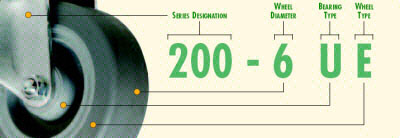

Wheel Types
| D | Payductile Ductile Iron |
| E | Durakush Thermoplastic Rubber |
| G | V-Grooved Semi-Steel |
| H | Payrock Hard Rubber |
| J | Peejay Polyolefin |
| K, R | Mirakush Polyurethane |
| L | Paythane Poly Mold-on |
| M | Plexite Phenolic |
| N | Broncushion Rubber Mold-On |
| P | Payvulc Mold-On Rubber |
| S | Payron Semi-Steel |
| T, F | Miratek Polyurethane |
| V | Bronco Mold-On Rubber |
| W | Full Pneumatic |
| X | Payflex Soft Rubber |
Wheel Bearings
| B | Ball |
| D | Delrin |
| O | Oilite |
| P | Plain |
| T | Timken |
| U | Roller |
Accessories (Suffixes Only)
| TG | Thread Guards |
| WK | Wheel Brake |
| SK | Swivel/Wheel Brake |
| WB | Wheel Brake |
| SB | Scaffold Brake |
| PB | Plate Brake |
| SL | Swivel Lock |
| DW | Double Wheels |
| WS | Wheel Seals |
| SS | Swivel Seals |
How To Select?
Floor Surfaces
A most important consideration. If your floors require maximum protection, select a resilient wheel. If you desire capacity only, choose a metal wheel. If you want capacity and floor protection, we recommend a Plexite and/or Polyurethane wheel.
Floor Conditions
Are there metal chips? Harsh chemicals? Uneven surfaces? Elevator sills? Extreme heat or cold? If so, a metal wheel may be your best bet. For a complete review, please see our Wheel Selection page.
Capacity
We believe that it is wise to select “more caster than you think you need.” Payson is a member of the Institute of Caster Manufacturers and subscribes to virtually all of its suggested load ratings. Each load rating is based upon a manual operation of 3 to 5 mph over even floors. Your selection should have a large enough wheel to ride over obstructions smoothly and to transport the load with minimum effort.
Wheel Bearings
to start and sustain motion. In addition, they are quieter. Plain, Delrin, or Oilite bearings should be considered when the operation is intermittent and when the travel is short.
How To Maintain
Each Payson caster is constructed with precise quality, prelubricated and thoroughly inspected before it leaves our factory. Casters should be relubricated on a regular schedule, and nuts and bolts should be kept tight. If the caster is used constantly, it should be checked once a week. If used only intermittently, then once a month.
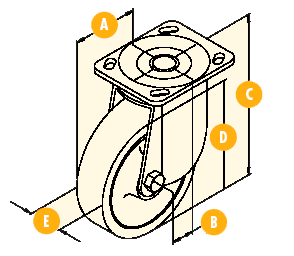
A. Swivel Radius
The distance measured horizontally from the center of the kingpin to the trailing edge of the wheel.
B. Offset
The horizontal distance from the center of the kingpin to the center of the axle.
C. Over-All Height
The vertical distance from the floor to the top of the mounting plate.
D. Caster Size
Determined by wheel diameter.
E. Tread Width
Wheel width at tread.
Contact Us
Payson Casters provides precision-engineered casters, wheels, and material handling solutions you can trust. Partner with us to keep your equipment and teams moving efficiently.
"*" indicates required fields